Think about these questions, or answer them aloud.
Spoken directions are a list of actions in order. Each action usually has two parts:
The speaker also uses landmarks: places that are easy to see, like a bank, a church or a bridge. Landmarks tell you when to do the next action. Follow the route with your finger on the map as you listen.
| You hear … | It means … |
|---|---|
| Go straight on. / Go straight ahead. | Keep walking in the same direction. |
| Turn left into Park Lane. | Turn left and walk along Park Lane. |
| Take the second turning on the right. | Don't turn at the first road on the right. Turn at the next one. |
| Go past the church. | Walk beside the church and keep going. |
| Cross the road. / Cross over. | Go to the other side of the road. |
| Keep going until you reach / get to the bridge. | Don't stop or turn before the bridge. |
| At the roundabout, go straight over. | Don't turn. Continue across to the other side. |
| at the end of the road | where the road stops |
| You hear … | Picture it |
|---|---|
| The bank is next to the café. | side by side |
| The bank is opposite the café. (US: across from) | on the other side of the road, facing it |
| The bank is between the café and the hotel. | café, bank, hotel in a line |
| It's on the corner of Mill Road and High Street. | where the two streets meet |
| It's in front of / behind the museum. | on the side facing the street / at the back |
| It's on your left / on your right. | from the direction you are walking |
In conversations, the person asking for directions often repeats them to check: “So I turn left at the bank?” Listen to the reply. If it is “No, right at the bank”, change your route.
Speakers also give extra help at the end: “It's opposite the station. You can't miss it.” This last landmark is often the best way to check your answer.
Choose the correct meaning.
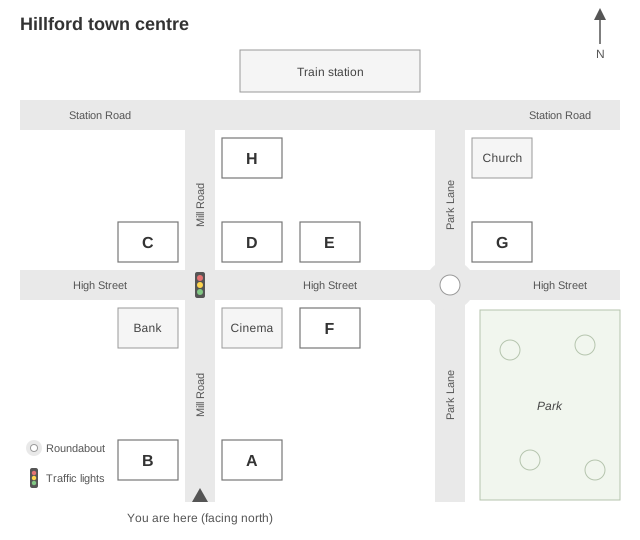
A strong listener puts a finger on “You are here” and moves it with each action.
Notice the trap: D is also “on the corner, on your right”, but it is on the corner of High Street, not at the end of Mill Road. The visitor's question about turning helps you, because the answer is no.
Look at the Hillford street plan. Listen and match each place with the correct letter, A–H, on the plan. There are three extra letters.
Listen to the phone call and complete Sam's notes. Write NO MORE THAN TWO WORDS AND/OR A NUMBER for each answer.
Listen to the talk. Choose the best answer to each question.
Listen to each sentence and type exactly what you hear.
Save words to review them later with flashcards.
“Take the first turning on the right.”
“Turn left at the traffic lights.”
“Go straight over the roundabout.”
“The library is opposite the bank.”
“The church is a useful landmark.”
“There's a café on the corner of Mill Road.”
“Our building is halfway along Hope Street.”
“You can leave your bag in the cloakroom.”
“The café is in the basement.”
“Take the lift to the second floor.”
